自动块化
背景
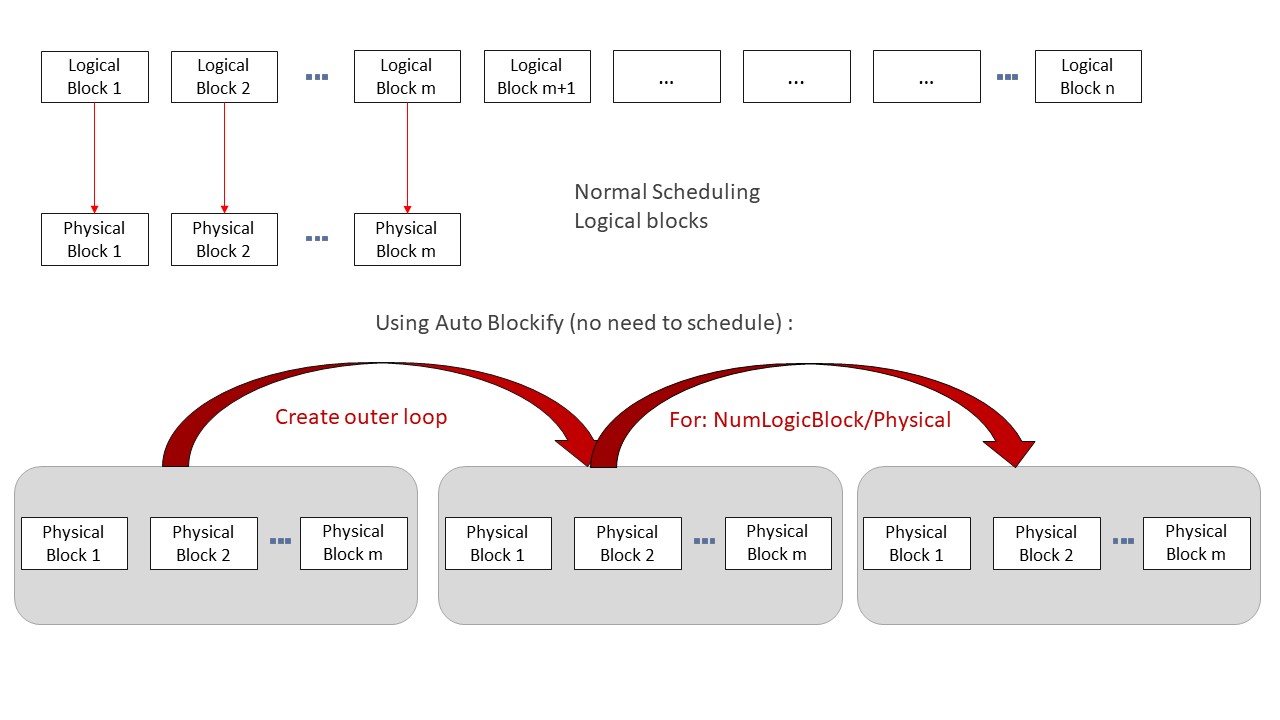
Auto Blockify Pass通过高效地将逻辑块映射到硬件物理块,是昇腾兼容算子执行链路的核心优化手段。当前架构下调度效率直接决定算子性能,逻辑块与物理块一对一映射可消除调度开销,实现性能提升。
结合AscendNPU IR架构使用实践,可用物理块数量通常远少于计算所需的逻辑块数量(物理块 < 50,逻辑块可能达到500+)。在这种10倍差距的场景下,加速效果可超过原始速度的两倍。
在运行Triton内核(通过triton-ascend)时,激活Auto Blockify逻辑的方式是添加以下标志:TRITON_ALL_PARALLEL。
对于AscendNPU IR开发者,可在bishengir-compile命令中添加以下标志:--enable-auto-blockify-loop。
算法原理
Auto Blockify Pass(AutoBlockifyParallelLoop)通过引入额外的循环层来变换IR,具体逻辑如下:
for outer from 0,...,ceildiv(logical_block_dim, physical_block_dim)
    for inner from 0,...,physical_block_dim  <- 作为 block.idx 使用
        use(min(outer * physical_block_dim + inner, logical_block_dim))
逻辑说明:
原始调度
原始模式通常如下所示:
block.idx = hivm.get_block_idx
use(block.idx)
-------等价于--------------
for block.idx from 0,...,logical_block_num
    use(block.idx)
使用
TRITON_ALL_PARALLEL的示例当用户在triton adapter中添加
TRITON_ALL_PARALLEL标志时,内核将被限制为仅使用最大物理块数量启动(假设逻辑块数 > 物理块数)。因此执行被限制为:for block.idx from 0,...,physical_block_num <- 来自 get_block_idx use(block.idx)仅依靠该循环逻辑无法覆盖全部计算索引,存在索引缺失问题。这也是引入Auto Blockify Pass补齐逻辑的原因:通过自动添加一层外部循环/块化来完善。
注:若不通过triton adapter接入,需要自行确保块维度的设置与上述一致。
使用Auto Blockify后的最终逻辑
经Auto Blockify Pass自动补全循环结构,最终执行逻辑如下:
for outer from 0,...,ceildiv(logical_block_dim, physical_block_dim)
    for inner from 0,...,physical_block_dim  <- 作为 block.idx 使用
        use(min(outer * physical_block_dim + inner, logical_block_dim))
接口说明:
该功能通过bishengir-compile中的--enable-auto-blockify-loop标志控制,也可通过bishengir-opt的--auto-blockify-parallel-loop标志直接调用。
为正确使用此功能,需注意以下几点:
Pass获取逻辑块数量的方式是查找标有
kLogicalBlockNumAttr属性(IR中为logical_block_num)的值,用户需确保该值可用,否则Pass调用时将失败。Pass还需要找到一个
hivm get_block_idx操作,该操作返回从0到块维度的块索引。使用AutoBlockify时,用户需要在调用设备内核时修改块维度(以最大物理块维度启动,与上述算法一致),使得blockidx操作返回0到physical_block_num范围内的值。
Triton Adapter:
该Pass已在triton adapter流水线中广泛使用。在此情况下正确使用AutoBlockify特性的方式是从前端(triton)通过TRITON_ALL_PARALLEL=1启用,该环境变量会同时完成准备工作(锁定块数量),然后自动以正确的标志调用相应的编译器命令。在triton流水线中有一个名为TritonGlobalKernelArgsToHIVMOpPass的Pass,会自动确保存在标记了logical_block_num的值,并创建所需的get_block_idx操作。
输入示例:
module attributes {dlti.target_system_spec = #dlti.target_system_spec<"NPU" : #hacc.target_device_spec<#dlti.dl_entry<"AI_CORE_COUNT", 20 : i32>, #dlti.dl_entry<"CUBE_CORE_COUNT", 20 : i32>, #dlti.dl_entry<"VECTOR_CORE_COUNT", 40 : i32>, #dlti.dl_entry<"UB_SIZE", 1572864 : i32>, #dlti.dl_entry<"L1_SIZE", 4194304 : i32>, #dlti.dl_entry<"L0A_SIZE", 524288 : i32>, #dlti.dl_entry<"L0B_SIZE", 524288 : i32>, #dlti.dl_entry<"L0C_SIZE", 1048576 : i32>, #dlti.dl_entry<"UB_ALIGN_SIZE", 256 : i32>, #dlti.dl_entry<"L1_ALIGN_SIZE", 256 : i32>, #dlti.dl_entry<"L0C_ALIGN_SIZE", 4096 : i32>>>, hivm.module_core_type = #hivm.module_core_type<AIV>} {
  func.func @add_kernel(%arg0: i64 {hacc.arg_type = #hacc.arg_type<ffts_base_address>}, %arg1: memref<?xi8> {hacc.arg_type = #hacc.arg_type<workspace>}, %arg2: memref<?xf32> {tt.divisibility = 16 : i32}, %arg3: memref<?xf32> {tt.divisibility = 16 : i32}, %arg4: memref<?xf32> {tt.divisibility = 16 : i32}, %arg5: i32 {tt.divisibility = 16 : i32}, %arg6: i32, %arg7: i32, %arg8: i32) attributes {WorkspaceArgIdx = 0 : i64, func_dyn_memref_args = dense<[false, true, true, true, true, false, false, false, false]> : vector<9xi1>, hacc.entry, hacc.function_kind = #hacc.function_kind<DEVICE>, hivm.func_core_type = #hivm.func_core_type<AIV>} {
    %c1024 = arith.constant 1024 : index
    %c1024_i32 = arith.constant 1024 : i32
    %c0 = arith.constant 0 : index
    hivm.hir.set_mask_norm
    %0 = arith.muli %arg6, %arg7 : i32
    %1 = arith.muli %0, %arg8 : i32
    annotation.mark %1 {logical_block_num} : i32 // 此 logical_block_num 是原始的大数值
    %2 = hivm.hir.get_block_idx -> i64   // for block.idx from 0,...,block_num
    %3 = arith.trunci %2 : i64 to i32
    %4 = arith.muli %arg8, %arg7 : i32
    %5 = arith.divsi %3, %4 : i32
    %6 = arith.remsi %5, %arg6 : i32
    %7 = arith.muli %6, %c1024_i32 : i32
    %8 = arith.index_cast %7 : i32 to index
    %reinterpret_cast = memref.reinterpret_cast %arg2 to offset: [%8], sizes: [1024], strides: [1] : memref<?xf32> to memref<1024xf32, strided<[1], offset: ?>>
    %alloc = memref.alloc() : memref<1024xf32>
    %9 = arith.addi %8, %c1024 : index
    %10 = arith.index_cast %arg5 : i32 to index
    %11 = arith.maxsi %8, %10 : index
    %12 = arith.minsi %9, %11 : index
    %13 = arith.subi %12, %8 : index
    %subview = memref.subview %reinterpret_cast[0] [%13] [1] : memref<1024xf32, strided<[1], offset: ?>> to memref<?xf32, strided<[1], offset: ?>>
    %subview_0 = memref.subview %alloc[0] [%13] [1] : memref<1024xf32> to memref<?xf32, strided<[1]>>
    hivm.hir.load ins(%subview : memref<?xf32, strided<[1], offset: ?>>) outs(%subview_0 : memref<?xf32, strided<[1]>>) left_padding_num = %c0 : index init_out_buffer = false
    %14 = bufferization.to_tensor %alloc restrict writable : memref<1024xf32>
    %reinterpret_cast_1 = memref.reinterpret_cast %arg3 to offset: [%8], sizes: [1024], strides: [1] : memref<?xf32> to memref<1024xf32, strided<[1], offset: ?>>
    %alloc_2 = memref.alloc() : memref<1024xf32>
    %subview_3 = memref.subview %reinterpret_cast_1[0] [%13] [1] : memref<1024xf32, strided<[1], offset: ?>> to memref<?xf32, strided<[1], offset: ?>>
    %subview_4 = memref.subview %alloc_2[0] [%13] [1] : memref<1024xf32> to memref<?xf32, strided<[1]>>
    hivm.hir.load ins(%subview_3 : memref<?xf32, strided<[1], offset: ?>>) outs(%subview_4 : memref<?xf32, strided<[1]>>) left_padding_num = %c0 : index init_out_buffer = false
    %15 = bufferization.to_tensor %alloc_2 restrict writable : memref<1024xf32>
    %16 = tensor.empty() : tensor<1024xf32>
    %17 = hivm.hir.vadd ins(%14, %15 : tensor<1024xf32>, tensor<1024xf32>) outs(%16 : tensor<1024xf32>) -> tensor<1024xf32>
    %reinterpret_cast_5 = memref.reinterpret_cast %arg4 to offset: [%8], sizes: [1024], strides: [1] : memref<?xf32> to memref<1024xf32, strided<[1], offset: ?>>
    %extracted_slice = tensor.extract_slice %17[0] [%13] [1] : tensor<1024xf32> to tensor<?xf32>
    %subview_6 = memref.subview %reinterpret_cast_5[0] [%13] [1] : memref<1024xf32, strided<[1], offset: ?>> to memref<?xf32, strided<[1], offset: ?>>
    hivm.hir.store ins(%extracted_slice : tensor<?xf32>) outs(%subview_6 : memref<?xf32, strided<[1], offset: ?>>)
    return
  }
}
输出示例:
module attributes {dlti.target_system_spec = #dlti.target_system_spec<"NPU" : #hacc.target_device_spec<#dlti.dl_entry<"AI_CORE_COUNT", 20 : i32>, #dlti.dl_entry<"CUBE_CORE_COUNT", 20 : i32>, #dlti.dl_entry<"VECTOR_CORE_COUNT", 40 : i32>, #dlti.dl_entry<"UB_SIZE", 1572864 : i32>, #dlti.dl_entry<"L1_SIZE", 4194304 : i32>, #dlti.dl_entry<"L0A_SIZE", 524288 : i32>, #dlti.dl_entry<"L0B_SIZE", 524288 : i32>, #dlti.dl_entry<"L0C_SIZE", 1048576 : i32>, #dlti.dl_entry<"UB_ALIGN_SIZE", 256 : i32>, #dlti.dl_entry<"L1_ALIGN_SIZE", 256 : i32>, #dlti.dl_entry<"L0C_ALIGN_SIZE", 4096 : i32>>>, hivm.module_core_type = #hivm.module_core_type<AIV>} {
  func.func @add_kernel(%arg0: i64 {hacc.arg_type = #hacc.arg_type<ffts_base_address>}, %arg1: memref<?xi8> {hacc.arg_type = #hacc.arg_type<workspace>}, %arg2: memref<?xf32> {tt.divisibility = 16 : i32}, %arg3: memref<?xf32> {tt.divisibility = 16 : i32}, %arg4: memref<?xf32> {tt.divisibility = 16 : i32}, %arg5: i32 {tt.divisibility = 16 : i32}, %arg6: i32, %arg7: i32, %arg8: i32) attributes {WorkspaceArgIdx = 0 : i64, func_dyn_memref_args = dense<[false, true, true, true, true, false, false, false, false]> : vector<9xi1>, hacc.entry, hacc.function_kind = #hacc.function_kind<DEVICE>, hivm.func_core_type = #hivm.func_core_type<AIV>} {
    %0 = arith.muli %arg6, %arg7 : i32
    %1 = arith.muli %0, %arg8 : i32
    annotation.mark %1 {logical_block_num} : i32  // 此 logical_block_num 是原始的大数值
    %c0_i32 = arith.constant 0 : i32
    %c40_i32 = arith.constant 40 : i32 // 40 为此处的物理块数
    %2 = arith.ceildivsi %1, %c40_i32 : i32 // ceildiv(logical_block_num, physical_block_dim)
    %c1_i32 = arith.constant 1 : i32
    scf.for %arg9 = %c0_i32 to %2 step %c1_i32  : i32 { // 外层循环
      %c1024 = arith.constant 1024 : index
      %c1024_i32 = arith.constant 1024 : i32
      %c0 = arith.constant 0 : index
      hivm.hir.set_mask_norm
      %3 = hivm.hir.get_block_idx -> i64 // 内层循环(锁定到物理块)
      %4 = arith.trunci %3 : i64 to i32
      %5 = arith.muli %arg9, %c40_i32 : i32 // outer_i * physical_block_num
      %6 = arith.addi %5, %4 : i32 // outer_i * physical_block_num + inner
      %7 = arith.minsi %6, %1 : i32 // (min(outer*physical_block_dim + inner, logical_block_num))
      %8 = arith.extsi %7 : i32 to i64
      %9 = arith.trunci %8 : i64 to i32
      %10 = arith.muli %arg8, %arg7 : i32
      %11 = arith.divsi %9, %10 : i32
      %12 = arith.remsi %11, %arg6 : i32
      %13 = arith.muli %12, %c1024_i32 : i32
      %14 = arith.index_cast %13 : i32 to index
      %reinterpret_cast = memref.reinterpret_cast %arg2 to offset: [%14], sizes: [1024], strides: [1] : memref<?xf32> to memref<1024xf32, strided<[1], offset: ?>>
      %alloc = memref.alloc() : memref<1024xf32>
      %15 = arith.addi %14, %c1024 : index
      %16 = arith.index_cast %arg5 : i32 to index
      %17 = arith.maxsi %14, %16 : index
      %18 = arith.minsi %15, %17 : index
      %19 = arith.subi %18, %14 : index
      %subview = memref.subview %reinterpret_cast[0] [%19] [1] : memref<1024xf32, strided<[1], offset: ?>> to memref<?xf32, strided<[1], offset: ?>>
      %subview_0 = memref.subview %alloc[0] [%19] [1] : memref<1024xf32> to memref<?xf32, strided<[1]>>
      hivm.hir.load ins(%subview : memref<?xf32, strided<[1], offset: ?>>) outs(%subview_0 : memref<?xf32, strided<[1]>>) left_padding_num = %c0 : index
      %20 = bufferization.to_tensor %alloc restrict writable : memref<1024xf32>
      %reinterpret_cast_1 = memref.reinterpret_cast %arg3 to offset: [%14], sizes: [1024], strides: [1] : memref<?xf32> to memref<1024xf32, strided<[1], offset: ?>>
      %alloc_2 = memref.alloc() : memref<1024xf32>
      %subview_3 = memref.subview %reinterpret_cast_1[0] [%19] [1] : memref<1024xf32, strided<[1], offset: ?>> to memref<?xf32, strided<[1], offset: ?>>
      %subview_4 = memref.subview %alloc_2[0] [%19] [1] : memref<1024xf32> to memref<?xf32, strided<[1]>>
      hivm.hir.load ins(%subview_3 : memref<?xf32, strided<[1], offset: ?>>) outs(%subview_4 : memref<?xf32, strided<[1]>>) left_padding_num = %c0 : index
      %21 = bufferization.to_tensor %alloc_2 restrict writable : memref<1024xf32>
      %22 = tensor.empty() : tensor<1024xf32>
      %23 = hivm.hir.vadd ins(%20, %21 : tensor<1024xf32>, tensor<1024xf32>) outs(%22 : tensor<1024xf32>) -> tensor<1024xf32>
      %reinterpret_cast_5 = memref.reinterpret_cast %arg4 to offset: [%14], sizes: [1024], strides: [1] : memref<?xf32> to memref<1024xf32, strided<[1], offset: ?>>
      %extracted_slice = tensor.extract_slice %23[0] [%19] [1] : tensor<1024xf32> to tensor<?xf32>
      %subview_6 = memref.subview %reinterpret_cast_5[0] [%19] [1] : memref<1024xf32, strided<[1], offset: ?>> to memref<?xf32, strided<[1], offset: ?>>
      hivm.hir.store ins(%extracted_slice : tensor<?xf32>) outs(%subview_6 : memref<?xf32, strided<[1], offset: ?>>)
    }
    return
  }
}
约束
可并行性:Auto Blockify算法仅适用于完全可并行的代码。这意味着各逻辑块的计算与访问必须可以安全地并行执行,块间不存在依赖关系。
使用场景:若逻辑块数量非常小,则此Pass不会带来任何优势。